The toll of the Iran war on human life and security is much discussed but there is another dimension: its environmental impact. Vanessa Spedding reports.
Responsible Science blog; 4 May 2026
On 19 March 2026, according to news reports [1,2], Israel bombed ships, a command centre and other infrastructure at the Iranian naval port of Bandar Anzali, on the Caspian Sea. Israel subsequently struck concealed air defence installations within a forested area in the same region [3].
These attacks were just a small part of the bombardment of the wider region that started with the unprovoked Israel-US attack on Iran at the end of February 2026 (codenamed Operation Roaring Lion in Israel and Operation Epic Fury in the US) and continued (including retaliations from Iran) until a ceasefire on 8 April which, at the time of writing, looks to be unravelling.
Forest at risk
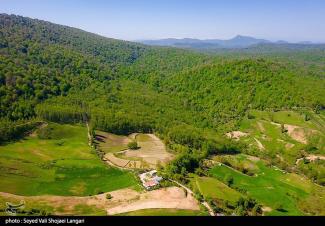
Bandar Anzali, in Gilan Province, lies just a few kilometres from the edge of the Hyrcanian Forest – an ecologically rich area situated between the southern coast of the Caspian Sea and the northern slopes of the Alborz mountain range, and stretching into Azerbaijan. This area’s complex topography, heavy rainfall, high humidity, and cooler temperatures have produced unique ecosystems considered to be between 25 and 50 million years old, which feature a range of plant and animal species that survived the ice age and can only be found as fossils in Europe [4].
It is also exceptionally beautiful: mountainous and covered with dense, deciduous forest (see image, taken before the war) – perhaps not the landscape that first comes to mind when thinking of Iran.
The Caspian Sea itself is home to 10 unique ecosystem types, including populations of an endangered seal species, sturgeon and a variety of migratory bird species.
While these bombardments, and others in Iran’s Caspian coastal region, are not confirmed to have caused direct damage to the forest or the sea, the chance that the close proximity has resulted in damaging spillover effects from pollution, shrapnel and heat is considered to be high [5]. These threats come on top of climate-induced drought – which is both lowering sea levels [6] and stressing the forest – and follow extensive forest fires in 2025 [7].
The impacts of the war on this particular area have received little scrutiny or media attention, but are highlighted here as an example of how conflict causes harm to not only human but also more-than-human life wherever it occurs, and how even in an ecologically precious, world heritage zone, this is normalised by omission from public discourse.
Bombing oil facilities
Some of the environmental impacts of this war have, however, received significant media coverage. This is in part thanks to the dramatic images that emerged following Israeli attacks on four oil facilities in the Tehran area (the Aqdasieh oil depot, the Shahran oil facility, the Tehran oil refinery and the Karaj oil depot, to the west of Tehran) on 7-8 March. These resulted in several large and persistent fires, which produced thick plumes of toxic black smoke and an ensuing, toxic “black rain” over the city [8].
An assessment from the Conflict and Environment Observatory [9] points out that this smoke will have comprised a mixture of gases and particles produced by the incomplete combustion of hydrocarbons and industrial materials, including pollutants such as carbon monoxide, sulphur dioxide, nitrogen oxides and volatile organic compounds (VOCs), alongside particles composed of soot, organic material and trace metals. Exposure to these, especially to the particles, can lead to respiratory disorders and inflammatory effects.
In the longer-term, the impacts include pollution of public water infrastructure, soil, natural water bodies, and of human and ecological communities further afield because of long-range transportation of smoke by air currents. There is also a climate impact of these attacks: CEOBS suggests uncontrolled combustion may lead to relatively more emissions of methane, ozone and short-lived ‘climate-forcers’ such as black carbon than if the oil products had been burned in the intended way.
Israel claimed to have bombed some 30 oil facilities in this way [9] including Iran’s South Pars gas field, which triggered retaliatory attacks by Iran on energy infrastructure in other Gulf states. The total environmental and climate fallout from the destruction of fossil fuel infrastructure in the Gulf region is as yet uncalculated.
Huge munitions impact
Overall, the number of bombs fired by Israel at Iranian sites is reported to amount to up to 18,000 [10]. The US, by just 6 March, was reported to have dropped 3,000 [11]. An up-to-date figure has not been released but a post on social media site ‘X’ [12] revealed the extent of the military equipment deployed by the US alone to this conflict, naming bombers, stealth bombers, fighter jets, nuclear powered submarines and military helicopters among many others in an extensive list. Their energy consumption and associated greenhouse gas emissions, as well as those released by the explosions, is also hard to calculate, but clearly significant. One analysis [13] estimated the total greenhouse gas emissions from just the first 14 days of the Israel-US assault – from fuel use, embodied carbon in equipment, emissions from missile and drone explosions and the destruction of some 20,000 civilian buildings – to be more than 5 million tonnes of carbon dioxide equivalent. This is higher than the total emitted by Iceland in 2024 and apparently represents more than $1.3 billion in climate damage – and these figures apply to just the first half of the conflict.
While consternation has rightly focused on the human death and suffering caused by this war, and the risks of escalation, it’s clear that the wide-ranging bombing and drone attacks in various locations have also had immensely detrimental effects on air, water, soil, biodiversity and climate. As of 27 March, CEOBS was reporting potential environmental harm at 232 out of 300 incident locations, in Iran and also from subsequent attacks on Iraq, Israel, Kuwait, Jordan, Cyprus, Bahrain, Qatar, the UAE, Saudi Arabia, Oman and Azerbaijan [14]. These incidents include marine pollution, pollution from military sites and material (which can include fuels, oils, heavy metals, energetic compounds and PFAS ‘forever chemicals’) and pollution from fires (which can release dioxins and furans). Pollution such as this can linger and spread for many years.
The geographical focus of the attacks on Iran has been the west and north of the country, targeting its military and energy infrastructure, but also civilian areas including the capital, Tehran. CEOBS has identified several incident sites near cities, suggesting risk of public exposure to toxins, and also many on military facilities in rural areas. These areas overlap with three of the country’s four ecological zones: the mountainous, forested North, described above, the arid central regions, and the marine environments of the Gulf of Oman and Persian Gulf, featuring variously mangroves, seagrass meadows, coral communities, and intertidal flats and estuaries.
For all the impersonal lists of war equipment, megatonnes of carbon dioxide, chemical names, climate budgets and casualty figures, it is suffering, death, and harm to life, both human and more-than-human, in cities but also in distinct and diverse ecological regions such as these, now and into the future, that conflicts such as the Iran war cause. Assuming a perspective of ‘landscape as relationship’, as proposed in another CEOBS article [15], offers the possibility of resolving the perceived split between harm to people and harm to the environment. The observation in that article that “war disrupts the relationship between people and every other element of the landscape” might lead to a conceptualisation of peace as the restoration of that relationship.
----------------------
Vanessa Spedding is an independent science writer and editor with degrees in chemical physics and information design. She is currently studying for a PhD in ecolinguistics with the Open University.
References
1. Asadzade U (2026). With Israeli Strike On A Caspian Port, Iran War Could Endanger Russia’s Trade Route With Tehran. RadioFreeEurope/RadioLiberty. 1 April. https://www.rferl.org/a/israel-hits-the-caspian-sea-port/33718210.html
2. Malyasov D (2026). Israel hits Iranian naval base and vessels in Caspian Sea. Defence Blog. 19 March. https://defence-blog.com/israel-hits-iranian-naval-base-and-vessels-in-caspian-sea/
3. Smith Z (2026). Israel Strikes New Targets on Iranian Sites Near Caspian Sea. The Wall Street Journal. 30 March. https://www.wsj.com/livecoverage/iran-war-news-updates/card/israel-strikes-new-targets-on-iranian-sites-near-caspian-sea-YEpfcxADlAo5V56Pc2ss
4. IUCN (undated). Hyrcanian Forests. World Heritage Outlook. https://worldheritageoutlook.iucn.org/explore-sites/hyrcanian-forests
5. TASS Russian News Agency (2026). Attacks on Iran’s Caspian port threaten environment, regional trade — diplomat. 23 April. https://tass.com/world/2121379
6. Court R et al (2025). Rapid decline of Caspian Sea level threatens ecosystem integrity, biodiversity protection, and human infrastructure. Communications Earth & Environment, 6(1), p.261. https://doi.org/10.1038/s43247-025-02212-5
7. The New York Times (2025). Fire Threatens Iran’s Ancient Forest, a World Heritage Site. 23 November. https://www.nytimes.com/2025/11/23/world/europe/iran-fire-hyrcanian-forests.html
8. Webber T (2026). After attacks on Iran’s oil facilities, toxic black rain endangers the public. AP News. 15 March. https://apnews.com/article/iran-war-black-rain-pollution-d5f67db4a772775c83dfa3fd303cf25d
9. CEOBS (2026a). Belligerents argue that attacks on oil facilities are militarily legitimate but in Tehran the civilian impact has been huge. Conflict and Environment Observatory. 9 March. https://ceobs.org/black-rain-the-health-and-environmental-risks-from-tehrans-oil-fires/
10. aNEWS (2026). Israel says it dropped 18,000 bombs on Iran in five weeks of war. 11 April. https://www.anews.com.tr/world/2026/04/11/israel-says-it-dropped-18000-bombs-on-iran-in-five-weeks-of-war
11. Breaking Defense (2026). 3,000 strikes, 43 ships hit: US operations against Iran by the numbers. 6 March. https://breakingdefense.com/2026/03/2000-strikes-30-ships-down-us-operations-against-iran-by-the-numbers/
12. US Central Command (2026). Operation Epic Fury: March 28th Update. https://x.com/CENTCOM/status/2037956369173696547/photo/3
13. Otu-Larbi F, Bigger P, Neimark B (2026). Two weeks of war in Iran unleashed more carbon pollution than Iceland does in a year. Climate and Community Institute. 21 March. https://climatecommunityinstitute.substack.com/p/iran-war-pollution
14. CEOBS (2026b). Three days of Operation Epic Fury: a rapid overview of environmental harm in Iran and the region. March. https://ceobs.org/three-days-of-operation-epic-fury-rapid-overview-of-environmental-harm-in-iran-and-the-region/
15. Siddique S, Watkins S (2026). Landscape: a human lens on the environmental cost of war. CEOBS. 21 April. https://ceobs.org/landscape-a-human-lens-on-the-environmental-cost-of-war/
[image credit: Seyed Vali Shojaei Langari via Wikimedia]