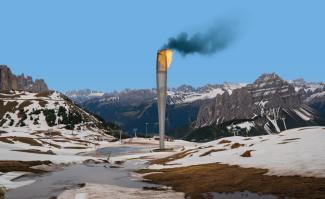
Dr Stuart Parkinson and Andrew Simms summarise SGR's new report showing how induced GHG emissions from high carbon sponsorship push up the climate impacts of the Winter Games.
Article from Responsible Science journal, no.8; advance online publication: 19 January 2026
In recent years, the host of the 2026 Winter Olympics, Italy, has lost a reported 265 ski resorts, while France, due to host the next Winter Games in 2030 has seen the loss of over 180 resorts. The disappearance of snow due to global heating is a prime factor undermining winter sports, with the Games increasingly dependent on artificial snow. Yet, through the promotion of high carbon corporations in Olympic sponsorship deals - for example, oil and gas companies, airlines and car-makers - the Winter Games are in danger of torching their own future. This is the main conclusion of a new report by the New Weather Institute (NWI) and Scientists for Global Responsibility (SGR), in association with Champions for Earth.
The key findings of the report are:
- Based only on official data - and excluding emissions related to sponsorship deals with major polluters - this report estimates that the 2026 Winter Olympics in Milan Cortina will cause greenhouse gas emissions of about 930,000 tonnes of carbon dioxide equivalent (tCO2e), with the largest contribution – about 410,000 tCO2e – being due to spectator travel.
- Based on climate research, this total will in the coming years cause a loss of approximately 2.3 square kilometres (km2) of snow cover and over 14 million tonnes (Mt) of glacier ice – major impacts on exactly the environment needed to support winter sports.
- But this report also estimates that sponsorship deals between the 2026 Winter Olympics at Milan Cortina promoting three major, heavily polluting corporations - oil and gas producer, Eni; car-maker, Stellantis (whose brands include Maserati and Fiat); and ITA Airways - will induce additional greenhouse gas (GHG) emissions of about 1.3 million tCO2e - about 40% more than the rest of the estimated carbon footprint of the event - including emissions due to preparation, infrastructure construction, hosting, and spectator travel. These emissions are not normally included in carbon footprint assessments, but they are a key part of the bigger picture.
- These extra emissions will lead to additional future losses of 3.2 km2 of snow cover and over 20 Mt of glacier ice. That puts the total impact for the Games and these three sponsorship deals at 5.5 km2 of snow cover loss and over 34 Mt of glacier ice.
- The additional emissions induced by the sponsorship deal with Eni alone are estimated to be nearly 700,000 tCO2e and will push on its own the estimated losses of 1.7 km2 of snow cover and 11 Mt of glacier ice.
- Based on an assessment of several Winter Olympics, the most effective actions for reducing GHG emissions would be to: end sponsorship deals with high carbon corporations; avoid construction of new venues and other infrastructure; and markedly reduce the numbers of spectators travelling by air.
Without change, Milan Cortina will hand a baton of melting snow and ice to the French Alpine hosts of 2030. But, instead of being a billboard for the carbon emissions behind climate breakdown, the Winter Games could draw on its own recent history to be a poster child for progress towards clean, pollution free sport.
Inspired by athletes speaking out, and medical experts explaining the scientific evidence, it was the Calgary Winter Games in 1988 that took a decisive stand against tobacco advertising and sponsorship that ultimately rid the Olympics, and much of sport more widely, of its lethal influence. With the death toll today from the air pollution alone caused by burning fossil fuels on a par with tobacco, the time has come for the Olympics to end a link that threatens not just its athletes, but its very existence.
Dr Stuart Parkinson is Executive Director of SGR. He holds a PhD in climate science, and is a former expert reviewer for the Intergovernmental Panel on Climate Change. Andrew Simms in Co-director of the NWI and Assistant Director of SGR. He has written widely on climate issues, and is the co-ordinator of the Badvertising campaign.
[image credit: NWI]