Media release: 6 July 2026
Key points
- New in-depth study on military climate strategies of 26 nations shows little progress on reducing carbon emissions
- Only 9 of 26 militaries had near-term emission reduction targets; only 4 had near-term targets covering all core emissions; only 2 had targets consistent with aim of net zero by around 2050
- Most emission reduction achieved to date has relied on civilian action (especially decarbonisation of national electricity grids), temporary reductions in military activity, or military base closure programmes
- Two most successful nations in achieving military emission reductions to date are Ireland and Switzerland, while nations with largest militaries – like USA, China, and Russia – do not have military emission reduction plans currently in force
- Study by Scientists for Global Responsibility (SGR), a leading research organisation in this field
Against a background of spiralling military budgets, a new in-depth report has been published assessing the carbon emission reduction plans for the militaries of 26 nations, mainly from Europe and North America.
The report’s findings give much cause for concern. They show that most military emissions within these 26 nations are not covered by any specific targets, most of the targets that do exist are unambitious, and most of the emission reduction achieved to date has relied on civilian action (especially decarbonisation of national electricity grids), temporary reductions in military activity, or military base closure programmes – rather than through lower carbon weapons technologies.
Only 9 of the 26 militaries have set near-term emission reduction targets, i.e. up to 2035. 4 have near-term targets covering 100% of core (Scope 1 and 2) emissions: Australia; Ireland; Slovenia; and Switzerland. The other 5 have near-term targets covering between 17% and 92% of core emissions: Canada; France; Germany; Norway; and the UK. The incomplete coverage of targets can cause serious confusion. Only 2 have targets consistent with reaching net zero emissions by around 2050: Ireland and Slovenia.
Only 1 military (Canada) has a target covering key supply-chain emissions (Scope 3), despite these emissions likely being the majority of the military carbon footprint.
7 militaries have reported on their progress in reducing core emissions. 2 of these have made significantly better progress than their peers: Ireland and Switzerland.
One area where militaries have had some success in reducing their emissions is at military bases, where programmes of building energy efficiency improvements and onsite renewable energy projects have been undertaken. These reductions have been achieved to varying degrees in: Australia; Canada; Germany; Ireland; Norway; Switzerland; and the UK.
The study has been published on the eve of the 2026 NATO Summit as NATO has both a climate change strategy and a new spending target – 5% of GDP on military and security activities – which previous research has shown is driving up emissions. 20 of the 26 countries included in this study are members of NATO. The study has also examined emission reduction commitments of NATO itself, and found them to have numerous loopholes.
The largest military spending nations – the USA, China, and Russia – do not currently have plans to reduce their military carbon emissions.
Dr Stuart Parkinson, report author and executive director of SGR said, “In recent years, some militaries – and NATO – have been talking up their green credentials. Our in-depth study shows that very few are making significant progress. Now even that limited progress that is being undermined by huge rearmament programmes, not least within NATO. As this summer’s extreme weather shows the climate crisis is getting rapidly worse. We cannot afford to allow militaries and their supply-chains to be exempt from serious action to reduce carbon emissions.”
Notes
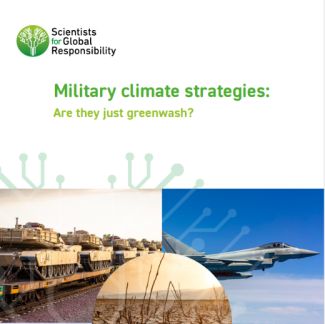
1. The new report is entitled Military climate strategies: are they just greenwash? It is available to download via:
https://www.sgr.org.uk/publications/military-climate-strategies-are-they-just-greenwash
2. The 26 nations investigated in the study are:
- 20 which are members of NATO – the top 15 by military expenditure, together with five others: USA; Germany; UK; France; Poland; Italy; Canada; Türkiye; Spain; Netherlands; Sweden; Norway; Denmark; Romania; Belgium; Greece; Portugal; Estonia; Luxembourg; and Slovenia;
- Three European nations which are not members of NATO: Switzerland; Austria; and Ireland;
- Three other non-European nations: Japan; Australia; and New Zealand.
NATO’s emission reduction plans are also included in the study.
3. Scientists for Global Responsibility (SGR) is a UK-based membership organisation which promotes responsible science and technology. Its membership includes hundreds of natural scientists, social scientists, and engineers. It carries out research, education, and advocacy work centred around science and technology for peace, social justice and environmental sustainability. For more information, see: https://www.sgr.org.uk/
4. Dr Stuart Parkinson is executive director of SGR. His background includes a PhD in climate science, experience as an expert reviewer for the Intergovernmental Panel on Climate Change, and work on military technologies and security strategies. He is lead author of several influential reports on military carbon emissions, see:
https://www.sgr.org.uk/projects/climate-change-military-main-outputs